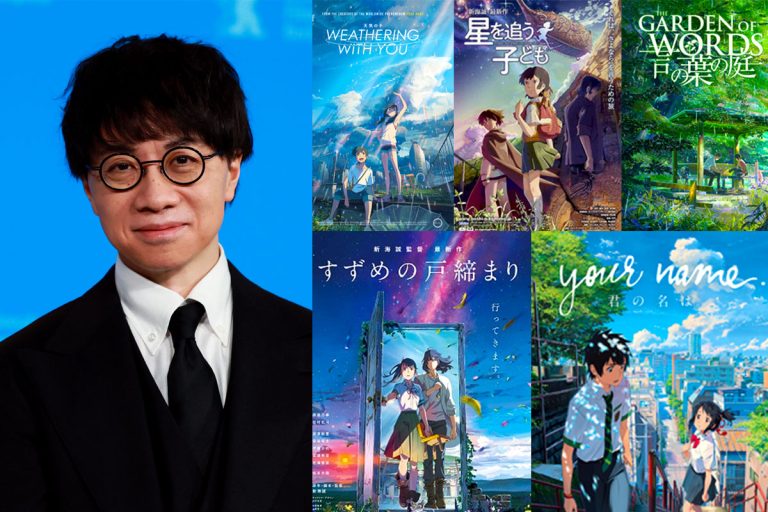
Whenever a new Makoto Shinkai film drops, the anime community has the exact same thought. You can pause the movie at almost any random time, take a screenshot, and use it as a desktop wallpaper. His films have a highly distinct, hyper-realistic aesthetic that instantly sets them apart from the rest of the industry. But what exactly is happening behind the scenes?
Makoto Shinkai has firmly established himself as one of the most important directors in modern anime history. While critics early in his career rushed to label him the next Hayao Miyazaki, Shinkai has proven over the years that his creative vision is entirely his own. Starting out as a solo animator and graphic designer working on video games, he eventually transitioned into directing, delivering massive, record-breaking global hits like Your Name, Weathering With You, and Suzume.
His narratives are famous for dealing with themes of emotional distance, young love, and natural disasters. However, long before the plot even gets moving, there is one specific element of a Shinkai film that immediately grabs the audience’s attention: his unbelievable, hyper-realistic art direction.
The truth is, Makoto Shinkai’s visual mastery is not just hiring talented artists to draw well. To understand why his movies look the way they do, you have to stop looking at him just as an animator and start looking at him as a cinematographer.
Here is the technical breakdown of how Makoto Shinkai creates the most stunning visuals in modern anime.
1. Simulating Physical Camera Lenses
Most standard anime is drawn completely flat. Characters and backgrounds are in perfect focus because there is no physical camera involved. Makoto Shinkai breaks this rule.
He actively designs his scenes to mimic the mechanics of real-world photography and video production. If you pay close attention to his shots, you will notice:
- Shallow Depth of Field: He frequently blurs out the foreground or background to force the viewer’s eye to where he wants it, like using a prime lens on a DSLR.
- Chromatic Aberration: This is the slight colour-fringing (usually red and blue) that happens at the edges of objects when shooting with physical camera lenses. Makoto Shinkai adds this digital distortion on purpose to make the 2D drawing feel like actual raw footage.
- Lens Flares: He is famous for tracking heavy, realistic sunlight flares across the lens as the camera pans.
2. Hyper-Fixation on Lighting and Compositing
The core of Makoto Shinkai’s visual infrastructure is his post-production pipeline, specifically how he handles digital compositing.
In animation, compositing is the stage where the background art, the 2D character cells, and the visual effects (like rain, dust, or light rays) are stacked together. Shinkai’s team pushes this to the absolute limit. They do not just draw a blue sky; they map out exactly how the sunlight scatters through the clouds, how it reflects off a glass building, and how that secondary reflection hits the character’s face.
He heavily utilizes the Golden Hour (the period shortly after sunrise or before sunset) and the Blue Hour in his colour grading. This gives almost every outdoor scene an incredibly warm, nostalgic, or dramatic contrast.
3. Blending 2D and 3D Infrastructure
Shinkai is a master of hiding his 3D models. When you see those massive, sweeping camera pans around characters running through Tokyo or standing on mountains, drawing that entirely in 2D is inefficient.
Instead, his team builds full 3D environments. They animate the camera moving through that 3D space, and then they meticulously paint over the 3D models with 2D textures. Finally, they drop the 2D hand-drawn characters into the scene. Because his team handles the lighting across both the 2D and 3D assets, your brain registers it as one breath-taking shot.
4. High-Fidelity Rendering of Mundane Details
A major reason Makoto Shinkai’s films feel so immersive is his obsession with the mundane.
While most action-heavy anime put their budget into massive fight scenes, Shinkai pours resources into animating things we see every day. He will animate a highly detailed smartphone screen reflecting light, the complex mechanics of a train door sliding shut, a hyper-realistic bowl of ramen, or rain hitting a puddle.
By grounding the audience in a world where the boring, everyday objects look real, the supernatural or emotional elements of his stories hit harder when they finally happen.
The Bottom Line
Makoto Shinkai’s visual style is a perfect intersection of traditional artistry and high-level digital strategy. By treating his 2D canvases like physical camera setups and mastering the logic of light, he has built an undeniable signature style.