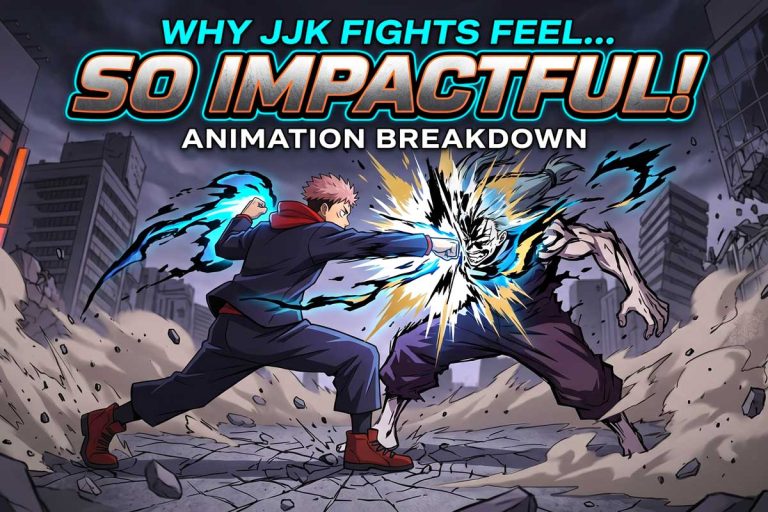
When you watch a fight in Jujutsu Kaisen, it doesn’t just look cool, it actually hurts. You can almost feel the blunt force of the punches through your screen.
For a long time, the standard formula for shonen anime fights relied heavily on floating in mid-air, screaming attack names, and firing massive beams of energy. While that style is fun, MAPPA threw that playbook out the window. They decided to make their magic-users throw actual hands.
If you have ever wondered why a simple right hook from Yuji Itadori gets you excited more than a massive energy explosion in other shows, it comes down to a few very specific animation techniques. Let’s break down exactly how the animators pull this off.
1. Grounded, Real-World Martial Arts
The foundation of a Jujutsu Kaisen fight is real-world combat. The animators study actual martial arts and apply them in their anime fights.
Look closely at Yuji’s fighting style. It is heavily inspired by Taido and traditional kickboxing. When he throws a punch, you see the entire kinetic chain. The animators draw his back foot planting into the dirt, his hips twisting, and his shoulder driving the momentum forward. Because the footwork and grappling are so realistic, it grounds the supernatural elements. When a character suddenly uses a cursed technique, it feels completely earned because the hand-to-hand combat leading up to it was so physically exhausting.
2. Treating the Camera Like a Physical Object
In most 2D animation, the camera stays locked in a wide shot so you can see the action clearly. Jujutsu Kaisen does the exact opposite.
Directors like Sunghoo Park treat the camera as if a real person is holding it while sprinting alongside the characters. The camera shakes when a heavy hit lands. It spins wildly around the characters during a grapple.
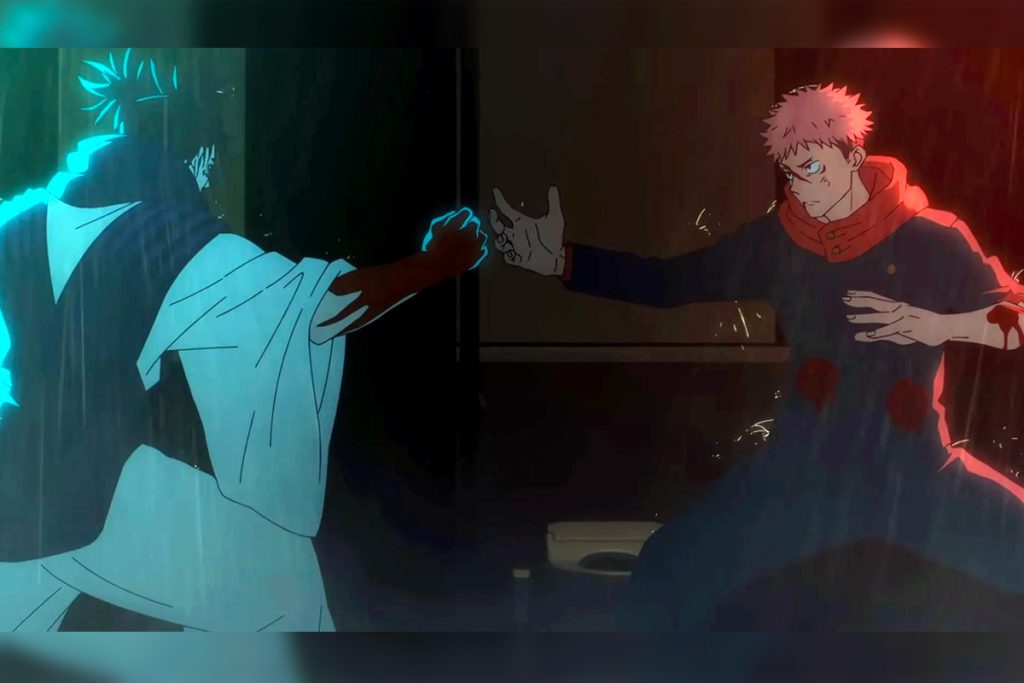
Think back to Yuji vs. Choso’s fight in the public bathroom. The animators used 3D background rotation to make the camera track the fighters as they smashed through stalls. This technique ruins your sense of safe distance as a viewer by dragging you directly into the claustrophobic chaos of the brawl.
3. The Art of the Impact Frame
You might not consciously notice impact frames, but your brain registers them. An impact frame is a split-second drawing usually just one or two frames long, flashed exactly at the point of contact. When Todo or Yuji lands a Black Flash, Jujutsu Kaisen animators don’t just draw a fist hitting a face. For a fraction of a second, the colours completely invert, or the screen flashes stark black and white.
During these frames, the line art completely changes. The clean, polished character outlines suddenly become rough, scratchy, and violently thick. By breaking the visual consistency of the show for just one frame, it tricks your brain into feeling a massive release of kinetic energy.
4. Respecting Weight and Momentum
Animation is just manipulating physics, and JJK animators respect the laws of inertia better than almost anyone else in the industry.
When a character gets hit in Jujutsu Kaisen, they don’t just slide backward on their feet like a video game character. They completely lose their center of gravity. They ragdoll, skip across the pavement, crash through concrete, and struggle to find their footing.
Even the debris has weight. When a building collapses during the Shibuya arc, the concrete doesn’t just turn into generic dust clouds. You see heavy, jagged chunks of rock crushing the environment. Because the environment reacts realistically to the violence, the viewer instinctively understands how dangerous the fight is.
5. Pacing: Flurries vs. Heavy Blows
If a fight is moving at 100 miles per hour the entire time, it actually gets boring. Your eyes adjust to the speed, and the hits stop feeling special.
The choreography in JJK uses extreme contrast to keep you hooked. The fighters will exchange a blindingly fast flurry of parries and blocks, then suddenly pause for a fraction of a second to wind up a massive, heavy blow. That tiny pause right before the hit connects and builds anticipation. It is the visual equivalent of taking a sharp breath before screaming.
Ultimately, Jujutsu Kaisen has set a brand new trend for modern action anime. It proved that you don’t need cosmic-level energy blasts to create hype. Sometimes, all you need is a perfectly animated, brutally heavy right hook.
What do you think of the fight styles and animation in Jujutsu Kaisen? Do you like them or do you have your reservations? Tell us in the comments below.